RF Series — Fully Wireless E32 Temperature Monitoring System
Fully Wireless Temperature Acquisition System
The RF series fully wireless temperature monitoring system: all communication between cloud server, wireless repeaters, and wireless collectors is completely wireless. Each collector has 8 channels and consumes power for only 0.45 seconds during data transmission. One charge lasts 14~80 days. Supports up to 4-level wireless repeater routing with fully automatic networking. 4G/WiFi/RJ45 or USB internet access. Free cloud server provided.
Key Features
- Fully wireless communication — cloud server to repeater to collector, all wireless
- Each collector has 8 channels; only 0.45 seconds power draw during transmission
- One charge lasts 14–80 days
- Up to 4-level wireless repeater routing with full auto-networking
- 4G/WiFi/RJ45 or USB internet access
- Free cloud server provided
- Wireless spread-spectrum technology
- Power-loss / breakpoint data catch-up and re-transmission
- Automatic reports, graphs, and analysis
- Over-temperature alarm push notifications
- Smart construction site platform integration support
FAQ
What is the overall architecture of the RF wireless monitoring system?
The RF wireless monitoring system supports two flexible deployment architectures:
Architecture 1: Cloud-Connected Mode
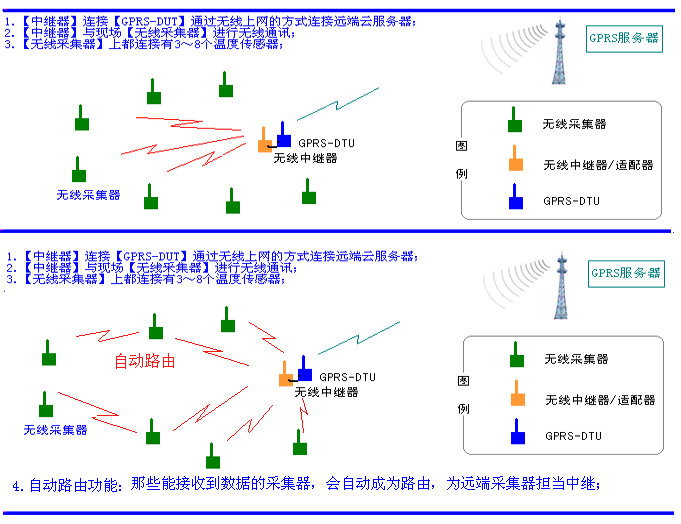
E32 collector → E32 repeater → Cloud platform
Fully wireless networking design — no signal cabling required. Ideal for retrofit projects where concrete is already poured or on-site wiring is difficult, enabling remote real-time monitoring.
Architecture 2: Local Monitoring Mode
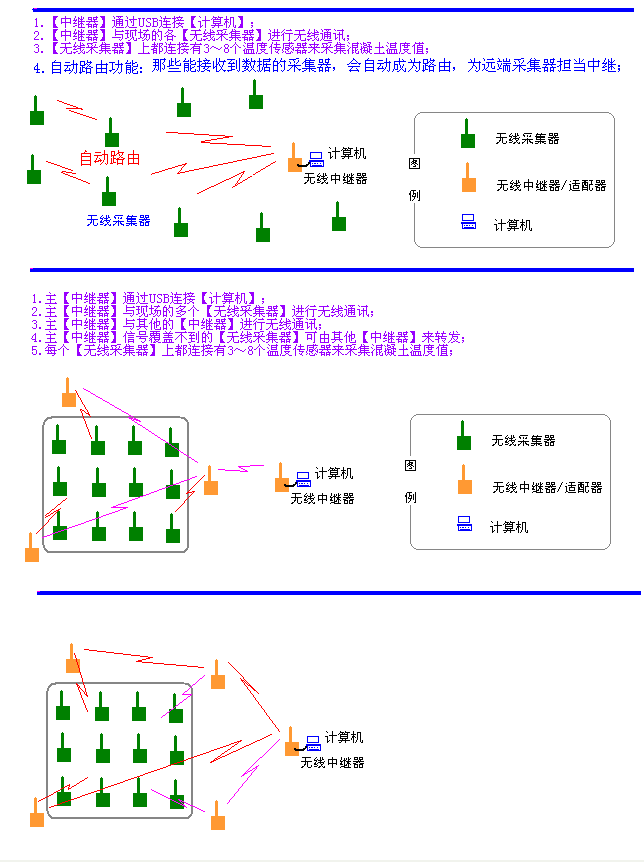
E32 collector → E32 repeater → On-site IPC (standalone software)
Data processed locally with no public internet dependency. Suitable for independent site management, network-restricted environments, or privacy-sensitive projects — monitoring and analysis completed via standalone software.
Architecture 1: Cloud-Connected Mode
E32 collector → E32 repeater → Cloud platform
Fully wireless networking design — no signal cabling required. Ideal for retrofit projects where concrete is already poured or on-site wiring is difficult, enabling remote real-time monitoring.
Architecture 2: Local Monitoring Mode
E32 collector → E32 repeater → On-site IPC (standalone software)
Data processed locally with no public internet dependency. Suitable for independent site management, network-restricted environments, or privacy-sensitive projects — monitoring and analysis completed via standalone software.
What is the 433MHz wireless range of the RF collector?
Longer range, rock-solid: RF collectors use 433MHz professional spread-spectrum communication with up to 500m line-of-sight range. Even with reinforced concrete obstruction on-site, a reliable 100–200m connection is maintained.
Smart relay: Exclusive collector routing mode. When a signal is blocked, neighboring collectors automatically become "signal relays," enabling multi-hop data transmission — no additional repeaters needed, ensuring full coverage even in complex environments.
Smart relay: Exclusive collector routing mode. When a signal is blocked, neighboring collectors automatically become "signal relays," enabling multi-hop data transmission — no additional repeaters needed, ensuring full coverage even in complex environments.
How many sensors can one RF collector support?
RF wireless collectors come in 4-channel and 8-channel models, connecting 4 or 8 temperature sensors respectively. Choose the model based on the number of sensors per monitoring point to optimize system cost.
How long does the RF collector battery last?
RF collectors use 1× 18650 Li-ion battery, lasting 28-80 days in normal mode (10-minute intervals), depending on transmission frequency and distance. Low battery alerts are sent automatically, with hot-swappable replacement.
How do I access RF system data? Is software installation required?
Cloud deployment (no installation, multi-device sync): Data is aggregated via E32 repeaters and encrypted/uploaded to the cloud server through 4G-DTU (or WiFi/wired network). Users need no client software — simply log in to the cloud platform via a browser to monitor real-time temperature, access historical curves, and query alarm records. The system fully supports mobile app and WeChat mini-program for true mobile productivity.
Local deployment (standalone, data-secure): For scenarios with high data sensitivity or limited network environments, standalone software can be deployed on an on-site IPC. Data is stored and processed locally with complete physical isolation, ensuring core data privacy and meeting stringent intranet compliance requirements.
Local deployment (standalone, data-secure): For scenarios with high data sensitivity or limited network environments, standalone software can be deployed on an on-site IPC. Data is stored and processed locally with complete physical isolation, ensuring core data privacy and meeting stringent intranet compliance requirements.
What is the data refresh rate of the RF system?
The collection interval is configurable from 1 to 60 minutes, defaulting to 10 minutes. Shorter intervals consume more battery. The system supports time-based scheduling — e.g., high frequency for the first 3 days after pouring, lower frequency later.
Does the RF system support temperature alarms?
Yes. The system supports multiple alarm conditions: max internal temperature, internal-external differential, cooling rate, etc. Alarm methods include local audio/visual, SMS, WeChat push, and cloud platform popups. Thresholds can be set per monitoring point.
Can the RF system manage multiple construction sites?
Yes. The cloud platform supports multi-project management. Each site deploys an independent RF system, with all data consolidated under one account. Users can view all sites on a map and switch between sites for real-time data and history.
How do I export historical data from the RF system?
The cloud platform supports multiple export formats: ① Excel raw data export; ② PDF monitoring reports (with temperature curves); ③ API interface for third-party system integration. Historical data is stored long-term on the cloud.
What are the advantages of the RF system over wired systems?
Key advantages: ① No cabling — quick installation, ideal for completed or renovation projects; ② Portable — equipment can be reused across projects; ③ Flexible expansion — add or remove collectors anytime. Trade-off: batteries need periodic replacement, and range is affected by environment.
Can the RF system integrate with smart construction site platforms?
Yes. RF system data can be pushed to various smart construction platforms via API, supporting JSON, XML, and other formats. We have successful integration experience with multiple platforms and can assist with technical integration.
Interested in this product?
Contact us for detailed specifications, pricing, and technical support.
Contact Us